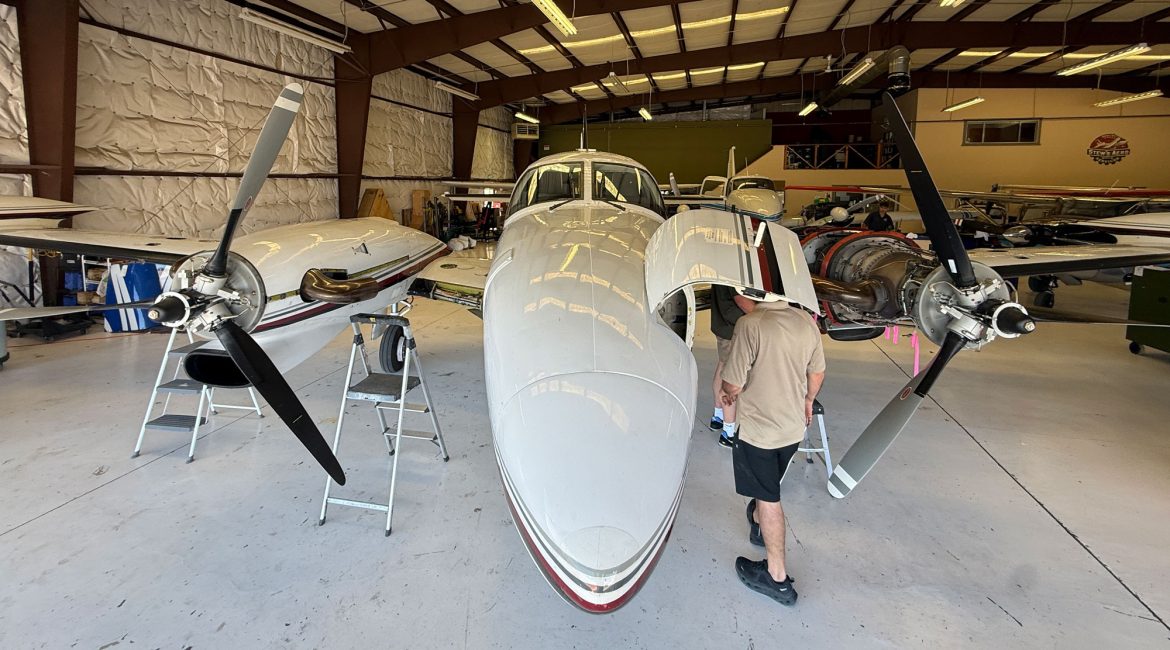
A Piper Cheyenne I is a serious airplane.
It is not a Cherokee with turbines. It is not a Navajo with a different sound. It is a pressurized, twin-engine turboprop with PT6 engines, constant-speed full-feathering props, retractable gear, environmental systems, deice equipment, cabin pressure systems, and enough moving parts to keep a lazy inspection from being worth much.
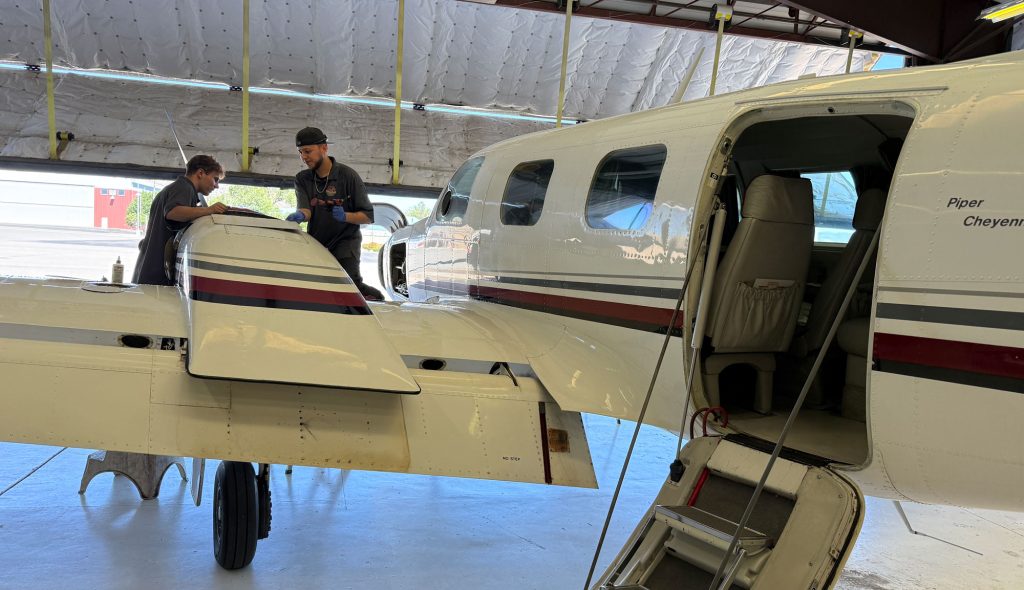
We have a Cheyenne I in the shop right now for a 12-month inspection, and it is a good reminder of what these airplanes need from a maintenance standpoint.
A Cheyenne can be a fantastic owner-flown turboprop. It gives you turbine reliability, pressurization, speed, and cabin-class utility without stepping all the way into a King Air or light jet. But the airplane has to be maintained like what it is.
This is not the kind of aircraft where a shop should be “taking a look” and hoping the obvious problems jump out.
The inspection has to be deliberate.
A Cheyenne Inspection Starts Before the Panels Come Off
On an airplane like this, the first part of the inspection is the records.
That may not sound exciting, but it matters.
Before you get too far into the airplane, you need to know what you are looking at. What inspection program is the aircraft on? What is due by calendar? What is due by hours? What has been deferred? What components are timed? What has been complied with? What has been missed? What service information applies? What does the engine history look like? What do the prop records say? Are there recurring squawks that keep showing up in different wording?
The airplane tells one story.
The logbooks tell another.
A good inspection compares both.
On a complex airplane, clean paint and a nice panel can distract people. The airplane may look sharp, but the records may show weak spots. Or the records may look fairly clean, but the airplane may have loose clamps, old hoses, tired wiring, seepage, worn hardware, or evidence that someone has been chasing the same problem for years.
You do not know until you slow down and look.
This Cheyenne Is on the M.O.R.E. Program
This particular Cheyenne is on the M.O.R.E. program, which makes the engine records and program compliance a major part of the inspection.
For owners, the appeal of M.O.R.E. is obvious. PT6 overhauls are expensive, and a legitimate approved program that can extend engine time has real value. But the program is not magic, and it is not a free pass to ignore the engines.
It is a maintenance program.
That means the value of the program depends on following the program. The required inspections, checks, oil analysis, trend monitoring, vibration checks, records, and documentation have to be current and properly tracked. If the airplane falls behind or the paperwork gets sloppy, the owner can lose the very value the program was supposed to protect.
This is where we see owners get surprised.
They hear “on program” and think that means the engine side is handled. Not necessarily. “On program” only means something if the airplane has actually been maintained in accordance with the program and the records support it.
So on a M.O.R.E. Cheyenne, we are not just looking at the engines and saying, “They look good.”
We are asking:
What does the program require?
What is due now?
What was done last time?
Are the oil analysis records there?
Is the trend monitoring current?
Are the vibration checks current?
Do the engine records support continued operation?
Do the logbook entries actually say what they need to say?
That is not paperwork for paperwork’s sake. On a PT6 airplane, the records are part of the value of the aircraft.
PT6 Engines Are Reliable, Not Invincible
The PT6 has a great reputation because it deserves one.
But reliable does not mean invincible.
A PT6 still lives in a nacelle full of heat, vibration, airflow, plumbing, wiring, controls, clamps, brackets, drains, and fittings. It still needs good inspections. It still needs clean records. It still needs mechanics who know the difference between normal turbine grime and something that deserves a closer look.
On a 12-month inspection, we are looking at the whole engine installation.
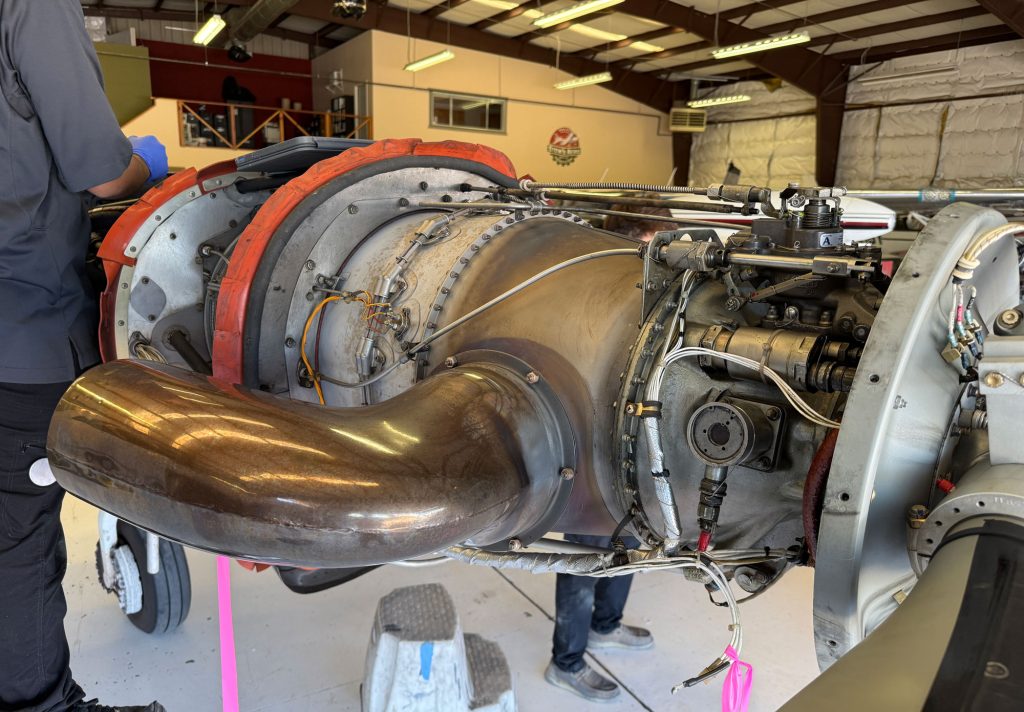
We are looking for fuel and oil leaks. We are looking at lines and fittings. We are looking for chafing. We are looking at control linkage and rigging. We are looking at mounts, brackets, clamps, drains, wiring, fire detection components where installed, exhaust areas, inlet condition, and signs of heat distress or movement.
A lot of turbine problems start as small clues.
A stain. A clamp that has been working. A line touching where it should not touch. A bracket starting to crack. A wire bundle that has been rubbing longer than anyone wants to admit. A drain that does not look right. Hardware that tells you someone was in there before and maybe did not leave it the way they should have.
A good mechanic pays attention to that stuff.
You do not inspect a Cheyenne engine installation by standing at the nacelle with a flashlight for thirty seconds and saying, “Looks dry.”
The Props Deserve Their Own Respect
On a Cheyenne I, the propellers are not just along for the ride.
They are constant-speed, full-feathering propellers turning turbine horsepower into thrust. They are part of the airplane’s performance, safety, engine control, and emergency behavior.
That means the prop inspection matters.
Blade condition matters. Nicks matter. Erosion matters. Boots matter. Spinner condition matters. Leakage matters. Hardware matters. Governor condition matters. Prop records matter. Compliance history matters.
Owners tend to notice big propeller damage. They may not notice smaller erosion, boot issues, seal leakage, spinner cracks, questionable repairs, or a maintenance history that needs research.
A propeller can look fine at a glance and still deserve a closer look.
And on a turboprop twin, you also care about how the engine and propeller systems work together. Feathering, governing, control rigging, and system condition are not academic details. They matter to how the aircraft behaves when everything is normal and when something is not.
Pressurization Is Not Just a Comfort Feature
A Cheyenne owner buys pressurization for a reason.
The airplane is meant to go higher, get above weather when appropriate, use turbine power efficiently, and make cross-country travel more comfortable and useful.
So when the pressurization system is weak, the airplane loses a big part of what makes it valuable.
During a 12-month inspection, we pay attention to the pieces that make the cabin pressure system work. Door seals, outflow valve condition, safety valve condition, controls, ducts, fittings, leakage signs, environmental system condition, and previous repair history all matter.
Pressurization problems can be annoying because they are not always dramatic. The airplane may pressurize, but not quite right. It may hold pressure some days and not others. It may have a cabin rate issue. It may have a seal that looks okay until you really inspect it. It may have a duct or connection that has been slowly getting worse.
This is where experience helps.
You are not just asking, “Does the system turn on?”
You are asking whether it is healthy, whether it is leaking, whether the controls and valves are doing what they should, and whether there is evidence of a problem that the owner has simply gotten used to.
Landing Gear: Do Not Just Swing It and Smile
A Cheyenne landing gear inspection deserves more than a gear swing and a thumbs-up.
The gear is carrying a heavy pressurized twin. It takes landing loads, side loads, brake loads, retraction cycles, extension cycles, vibration, dirt, moisture, and decades of maintenance history.
During inspection, we are looking for wear, looseness, leaks, corrosion, hydraulic issues, actuator concerns, uplock and downlock condition, rod ends, bushings, hardware, brake condition, tire condition, wheel well condition, chafing, wiring, hoses, switches, and rigging concerns.
A gear system can work and still be getting tired.
That is the part owners do not always see. The airplane may retract normally. It may extend normally. The lights may come on. Everything may feel fine from the cockpit.
Then you get in the wheel wells and start looking at the hardware, leaks, chafing, and wear points.
Landing gear problems rarely get cheaper by being ignored. A small leak, a loose component, a worn bushing, or a switch issue can become a much more expensive problem later. On a complex twin, this is not an area for lazy inspections.
Deice Equipment Needs to Be Treated Like You May Actually Need It
A Cheyenne is the kind of airplane that gets used for real transportation.
That usually means weather.
Even if an owner says, “I do not plan to fly in ice,” the airplane is still built and equipped for a different category of operation than a simple day-VFR piston single. If the airplane has boots, heated components, windshield heat, pitot heat, stall warning heat, prop heat, or other ice protection equipment, those systems need to be inspected and tested according to the applicable data.
Deice boots need to be looked at closely. Cracks, patches, age, adhesion, inflation, plumbing, valves, timers, and condition all matter. Heated components need to be checked. Wiring and connectors need attention. Indications matter.
The worst time to find out a system is weak is when the airplane is in the conditions that made the system important in the first place.
A good inspection treats weather equipment as part of the airplane’s mission, not as an accessory nobody wants to think about.
The Cabin and Airframe Still Matter
It is easy on a turboprop to get focused on engines, props, and pressurization.
But the rest of the airplane still needs the same disciplined inspection mindset.
We are looking at control cables, pulleys, bellcranks, hinges, rod ends, structure, corrosion-prone areas, windows, doors, latches, seals, access panels, drain paths, fuel areas, nacelles, empennage, flight controls, and anything else the inspection program calls for.
Older airplanes have stories hidden in them.
A previous repair. A stain under a floor panel. A rub mark behind an access cover. A wire that has been laying against structure. A fuel smell someone got used to. A door seal that has been blamed for a pressurization issue for years when the leak is actually somewhere else.
The inspection is where those stories start coming out.
Avionics and Electrical Systems Are Part of the Inspection Too
A Cheyenne may be older airframe-wise, but many of them have been upgraded over the years. Some have modern GPS units, engine monitors, transponders, ADS-B, autopilot changes, audio panels, radar, weather equipment, or partial panel upgrades layered over older wiring.
That can be fine when it is done cleanly.
It can also turn into a mess.
During an inspection, we are not doing a full avionics install review unless that is part of the work scope, but we are paying attention. Bad grounds, weak connectors, old circuit protection, abandoned wiring, poor routing, unsupported bundles, heat damage, and questionable prior installations can create real problems.
On a pressurized twin, electrical reliability matters. Autopilot reliability matters. Navigation and communication reliability matter. Pitot-static and transponder compliance matter. The airplane is usually being flown farther, faster, higher, and in more demanding conditions than a simple local-use airplane.
So no, the avionics bay and wiring do not get a pass.
A Good Inspection Separates “Must Fix” From “Watch This”
One of the most important things a shop can do for an owner is tell the truth without turning every finding into a five-alarm fire.
Complex aircraft can generate long squawk lists. That does not mean every squawk is equally urgent.
Some things need to be fixed before the aircraft flies. Some things need to be addressed soon. Some things need to be monitored. Some things are cosmetic. Some things are paperwork. Some things are symptoms of a bigger issue and need more troubleshooting before anyone throws parts at them.
A good shop should be able to explain the difference.
That is especially important on a Cheyenne because the invoices can get real. Owners deserve clear communication. They deserve to know what is required, what is recommended, what can reasonably wait, and what is smart to handle while the aircraft is already open.
There is a big difference between finding work and creating work.
A seasoned maintenance shop knows that.
Why a Part 145 Repair Station Process Helps
A Cheyenne is exactly the kind of airplane that benefits from a structured repair station environment.
That does not mean independent mechanics cannot be excellent. Many are. But a complex pressurized turboprop needs process, current technical data, inspection discipline, documentation control, tooling, and people who are used to looking at aircraft as systems.
At a properly run Part 145 repair station, there is more structure around the work. Findings are documented. Technical data is used. Inspectors are involved. Records are reviewed. The airplane is not treated like a collection of unrelated squawks.
That matters on a Cheyenne.
The PT6 engines matter. The M.O.R.E. program matters. The props matter. The landing gear matters. Pressurization matters. Deice matters. The electrical system matters. The logs matter.
The airplane is a system.
The inspection should be too.
What the Owner Gets From a Real 12-Month Inspection
A good 12-month inspection should give the owner more than a signed logbook.
It should give the owner a clearer picture of the airplane.
What is healthy?
What is aging?
What is coming due?
What is missing from the records?
What has been deferred?
What should be handled now?
What can wait?
What needs trend monitoring?
What does the airplane need to keep being useful for the mission?
That is the point.
A Cheyenne is not cheap to own, but poor maintenance decisions make it much more expensive. So does vague maintenance. So does skipping record research. So does ignoring early signs until they become dispatch problems.
A real inspection helps the owner stay ahead of the airplane.
Bring the Records, the Squawks, and the Mission
If you own a Cheyenne, Navajo, 414, 421, 340, 310, Baron, King Air, or another complex piston or turboprop aircraft, the inspection should match the airplane.
Bring the logbooks. Bring the engine and prop records. Bring the inspection status. Bring the M.O.R.E. program records if the engines are enrolled. Bring the squawk list, even if some items seem minor. Tell us how you use the airplane, what has changed, what has been deferred, and what kind of flying you expect to do over the next year.
A good inspection is not just about getting through the month.
It is about making sure the aircraft is ready for the way you actually fly it.
That is especially true with a pressurized twin turboprop.
The airplane is capable.
The inspection should be too.